
tailwinds of a remarkable year and handsome investor returns, Indian equities are set for an eventful journey in 2024, with a slew of local and global cues -- varying from interest rates to Lok Sabha polls to geopolitical happenings. Analysts are of the view that the bull run in the domestic equity market will continue, and over the next 3-6 months, the benchmark indices -- Sensex and Nifty -- could climb up to 7 per cent. In 2023, the 30-share BSE Sensex jumped 11,399.52 points or 18.73 per cent, and the NSE Nifty climbed 3,626.1 points or 20 per cent.

Relief Commissioner Alok Pandey told reporters that the government is constantly working to ensure that there is no loss of life due to the weather phenomenon.

The earnings are, however, expected to be down around 2 per cent on a sequential basis due to pent-up demand getting exhausted and the adverse impact of rising metals and energy prices on consumer goods and manufacturing companies.

Aided by the $57.8-billion merger of HDFC Bank and HDFC, India Inc reported its highest ever mergers and acquisitions in calendar 2022 at $171 billion as against deals worth $145 billion announced last year. The acquisition by the Adani group across cement, media and ports dominated the headlines with the conglomerate making its foray into the cement sector by buying Swiss materials firm Holcim's stake in Ambuja Cements for $6.5 billion. The Adani family's additional $4-billion open offer for Ambuja did not get a response because shareholders preferred to stay invested with the new owner.

Associated Cement Companies has reported a 122% increase in net profit at Rs 44.14 crore (Rs 441.4 million) for the quarter ended June 30, 2003 as against Rs 19.84 crore (Rs 198.4 million) of the last fiscal.
Answering questions from members in the assembly, Electricity Minister N Veerasamy urged the MRF management to find a solution to the labour issue in a week's time. If no solution was found, Chief Minister M Karunanidhi will be forced to intervene, he said.

Fiscal pressure for the Indian economy is gradually rising, suggested analysts at Jefferies in a recent note, as oil prices (Brent) - which are close to the $100 a barrel mark - continue to climb ahead of a busy election calendar. They added that the sharp rally in the equity markets during the last few months has made valuations costly. As a result, Jefferies expects the Indian markets to remain choppy in the near term.

Tata Motors was the biggest loser in the Sensex pack, skidding 1.77 per cent, followed by SBI, Power Grid, Tata Steel, Infosys, UltraTech Cement, Titan, Larsen & Toubro, Reliance Industries and Maruti. On the other hand, IndusInd Bank, Bharti Airtel, Asian Paints, NTPC, HCL Technologies, HDFC and Sun Pharma were the gainers.

Benchmark BSE Sensex and Nifty closed higher in a highly volatile trade on Monday, riding on the back of a recovery in IT, oil and financial stocks after a two-day fall. The 30-share Sensex recovered 169.51 points or 0.29 per cent to settle at 59,500.41. During the day, it rose by 313.34 points or 0.52 per cent to 59,644.24.
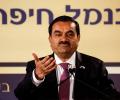
Stocks of all the ten listed Adani Group firms ended with gains on Wednesday, continuing the positive momentum amid a recovery in the broader equity market. Adani Enterprises stock jumped 14.70 per cent to settle at Rs 1,564.55 on the BSE. In intra-day trade, it rallied 15.83 per cent to Rs 1,580.

Fuelled by the $57.8-billion merger of HDFC twins (HDFC Ltd and HDFC Bank), M&A (merger and acquisition) transactions in India touched a record high of $124.2 billion in the first half of 2022-23. Bankers said with several transactions, including the government's stake sale in IDBI Bank and Hindustan Zinc in the pipeline, the ongoing financial year will end up as the best year for M&A activity in the country. Apart from the HDFC transaction, the $6.5-billion acquisition of Holcim stake by the Adani family and L&T's $3.2-billion acquisition of Mindtree added to the record transactions in the first half of FY23.

SC judges suspected a lack of objective criteria in the selection.

Cement shares have been outperformers on the stock market

At an aggregate level, the late ace investor's portfolio that was valued at Rs 32,445 crore as on March 31, 2023 is now worth Rs 35,979 crore.

Take a page out of the friendships of your favourite models.

From the Sensex pack, Mahindra & Mahindra climbed 3.71 per cent after the company reported an 18 per cent jump in its consolidated profit for the March quarter and the highest-ever annual profit of Rs 10,282 crore in FY23. Titan, Tata Steel, HDFC, UltraTech Cement, State Bank of India, ITC, IndusInd Bank, NTPC, HDFC Bank and Bajaj Finserv were the other major gainers. HCL Technologies, Power Grid, Maruti, Wipro, Tata Consultancy Services, ICICI Bank, Infosys, Tech Mahindra and Hindustan Unilever were the laggards.
Associated Cement Companies Ltd has posted a net profit of Rs 202.10 million for the quarter ended December 31, 2002 as compared to Rs 169.30 million in the quarter ended December 31, 2001.

Notwithstanding expectations of a pick-up in construction activity during a seasonally strong January-March quarter (fourth quarter) of 2022-23 (FY23), analysts are cautiously optimistic about the building material sector - encompassing paints, pipes, wood panels, tiles, metals, and cement - as volatile input costs, coupled with fears of a global slowdown, are making demand projections uncertain. Against this backdrop, analysts suggest investors stay selective and pick stocks of companies with stronger brand recall, expanding distribution network, diversified product profile, healthier balance sheet, and sustainable cash flow. "The government's various proposals under Budget 2023-24 (FY24) may lead to the building material segment growing between 8 per cent and 12 per cent for the next five years.

Adani Group is expected to report a 20 per cent rise in its earnings before interest, tax, depreciation, and amortisation (Ebitda) at Rs 61,200 crore for the year that ended in March 2023 (2022-23, or FY23), according to a note submitted by the group to lenders recently. The group had earned Ebitda of Rs 57,299 crore in the preceding financial year that ended in March 2022 (2021-22). The group's gross debt was Rs 2.27 trillion as of March 31, 2023, and has projected to not take on additional debt until it lowers its existing one.

Among the Sensex firms, Wipro, Axis Bank, Titan, UltraTech Cement and HDFC Bank, HDFC, HCL Tech and Reliance were the gainers.

The market capitalisation of BSE-listed firms reached an all-time high of Rs 299.90 lakh crore on Wednesday despite the Sensex falling marginally after a remarkable record-breaking rally in the last few trading sessions. The 30-share BSE Sensex dipped 33.01 points or 0.05 per cent to settle at 65,446.04, after rallying in the past five trading straight sessions. During the day, the benchmark hit a low of 65,256.49 and a high of 65,584.33.

Nifty50's earnings growth, estimated at 20 per cent by global research and brokerage firm Jefferies for financial year 2023-24 (FY24), will be amongst the top three in the Asian region, and is likely to outperform peers. Asean 40 index with 29.1 per cent estimated earnings growth and Straits Times Index (STI) with 29.1 per cent estimated earnings growth are the only two other indices in the Asian region that are likely to outperform India, suggests the recent Jefferies report, coauthored by Mahesh Nandurkar, their managing director along with Abhinav Sinha and Nishant Poddar.

Tata Motors, India's largest electric passenger vehicle manufacturer, has signed an agreement with ride-hailing company Uber to supply 25,000 electric vehicles (EVs), the company said. The agreement is the largest EV commitment between an automotive manufacturer and a ride-sharing platform in India. Under the agreement, Uber will deploy Tata Motors' XPRES-T EVs by partnering fleet operators in Delhi National Capital Region, Mumbai, Kolkata, Chennai, Hyderabad, Bengaluru, and Ahmedabad.
Tata Motors, India's largest electric passenger vehicle manufacturer, has signed an agreement with ride-hailing company Uber to supply 25,000 electric vehicles (EVs), the company said. The agreement is the largest EV commitment between an automotive manufacturer and a ride-sharing platform in India. Under the agreement, Uber will deploy Tata Motors' XPRES-T EVs by partnering fleet operators in Delhi National Capital Region, Mumbai, Kolkata, Chennai, Hyderabad, Bengaluru, and Ahmedabad.
Everything you wanted to know about 'Sunny' Gavaskar.

American online major Amazon seems to be almost doubling its India investment going by the company's recent announcement during Prime Minister Narendra Modi's state visit to the US. From the time the Seattle-headquartered company started its India journey in 2013, its investment into the country is pegged at $11 billion or roughly $1.1 billion a year. By committing a fresh round of $15 billion by 2030, the Jeff Bezos-founded company's investment would go up to more than $2 billion a year over the next seven years.
Richest Indian Gautam Adani's conglomerate has cited an improved net debt to operating profit ratio and more than halving of loans from public sector banks to allay concerns about it being overleveraged. In a 15-page note in response to CreditSights report calling the group overleveraged, it said companies in the group have consistently de-levered, with the net debt to Ebitda ratio declining to 3.2 times from 7.6 times in the last nine years. "The businesses operate on a simple yet robust and repeatable business model focused on development and origination, operations and management and capital management plan," the note, reviewed by PTI, said.

'If you are constructing the tunnel in the Himalayan region, then if you have constructed 10 metres of tunnel, first you will have to do proper treatment and ensure the stability of this constructed structure.' 'You cannot just throw concrete on the ceiling and sidewall of the tunnel for permanent stability. That will not work.'

What is driving the digital-first approach of traditional, legacy brands? Apart from the growing adoption of the internet in the country, brands are drawn to the agility of the medium.

"Lady candidates need not apply." So read the postscript in a job notice from Telco (now Tata Motors) on a notice board in the corridors of the Indian Institute of Science, Bangalore (now Bengaluru), in 1974. Irked, Sudha Murty, who was then pursuing her masters in computer science at the institute, wrote a postcard to JRD Tata, expressing her surprise at this gender discrimination, especially since the Tata Group were pioneers on many fronts. Shortly, Murty became the first woman on the firm's shop floor.
The archaic process of awarding coal blocks on a first-come-first-serve basis may soon be replaced by a more efficient and transparent competitive bidding process.

Promoters of 517 companies have pledged nearly 46.35 per cent of their shares, the highest since the 2008 global financial crisis.

The words 'industry', 'industrial development', 'jobs', and 'employment' have been ringing with higher frequency since Mamata Banerjee stepped into her third term with landslide victory after a high-octane election last year. "Our government's next target is industrial development," the chief minister (CM) had been heard stating at different public meetings in the past few months - perhaps setting the tone for the sixth edition of the Bengal Global Business Summit (BGBS) slated for later this month. Investor summits by any state are about intent, big numbers, and tall claims. Yet in competitive federalism, its importance as a marketing tool is undeniable.

From the Sensex pack, JSW Steel, Tata Steel, NTPC and UltraTech Cement emerged as major winners, closing the day with a gain of up to 3.33 per cent. On the other hand, Asian Paints, ITC, L&T and SBI were the laggards, ending the session up to 3.95 per cent lower. Of the 30 Sensex stocks, 14 closed the day in green, while on the 50-stock index Nifty 25 scrips ended with gains.

The engineering and construction (E&C) sector delivered an excellent performance in the last two financial years (FY2021-22 or FY22 and FY23's nine-months) and there's reason to believe that FY24 will also see outperformance. The sector has emerged from the pandemic with stronger balance sheets and more rational cost structures. It has a big order book and it should see new order flows accelerate in FY24.
